In this article
Dry-type transformers are widely used where fire safety, low maintenance and indoor installation matter. They are common in commercial buildings, data centers, hospitals, factories, renewable-energy facilities and infrastructure projects. Selecting one, however, involves more than choosing a kVA rating from a catalog. The specification must connect the electrical load, voltage system, operating environment, protection level, cooling arrangement and applicable standards.
This guide provides a practical, repeatable approach for selecting a cast-resin or VPI dry-type transformer before requesting a quotation.
1. Start with the real load—not only the connected load
The nameplate kVA must cover the maximum expected demand with sensible allowance for growth and operating conditions. List downstream loads, their rated power, diversity factor, duty cycle, power factor and starting or inrush characteristics. Motors, welders, rectifiers, UPS systems, EV chargers and variable-frequency drives affect a transformer very differently from steady resistive loads.
For a three-phase system, an initial estimate is: Transformer kVA = total kW / power factor. This is only a starting point. The final rating should reflect coincident maximum demand rather than adding every connected load at full output. A capacity margin supports expansion, but excessive oversizing increases first cost and no-load losses.
Also consider the load profile. A unit near full load continuously needs more thermal margin than one that sees short peaks. Include the hottest expected ambient condition.
2. Define primary and secondary voltage precisely
State both rated voltages, system frequency, phase count and required vector group. Typical examples include 11 kV/0.4 kV, 10 kV/0.4 kV, 20 kV/0.4 kV or 33 kV/0.4 kV at 50 Hz. Do not assume that “400 V” is enough: the line-to-line voltage, neutral arrangement, earthing method and local utility requirements also matter.
The vector group determines phase displacement and neutral availability. Dyn11 is common in distribution applications because it provides a low-voltage neutral, but the correct group depends on the existing network and whether transformers will operate in parallel. Mismatched voltage ratio, impedance, phase sequence or vector group can prevent safe parallel operation.
Specify the required tapping range. Off-circuit taps compensate for predictable supply-voltage variation; adjustment under load changes the equipment design and cost.
3. Match insulation class to voltage and environment
For dry-type transformers, insulation design is central to service life. Cast-resin transformers encapsulate windings in epoxy resin, giving strong resistance to humidity, dust and many harsh indoor conditions. VPI designs use vacuum-pressure impregnation and can be economical for clean, dry environments.
Ask for insulation class and temperature-rise limit, not just the phrase “dry type.” Common thermal classes include F and H. A conservative temperature rise can improve life expectancy where ambient temperature is high or ventilation is limited.
For humid, dusty, corrosive or coastal locations, provide full installation conditions. Environmental classification, anti-condensation heaters, enclosure material, coating system and creepage distances may all need adjustment.
4. Choose cooling and enclosure protection together
Most dry-type transformers are naturally air cooled, often called AN. Larger units or installations with temporary overload requirements may use forced-air cooling, commonly called AF. Forced cooling increases available capacity, but adds fans, controls, maintenance requirements and dependence on the cooling system.
The enclosure must protect the transformer without trapping heat. Indoor installations may use an open design or ventilated metal enclosure. Where dust, accidental contact or water ingress is a concern, specify the required IP rating. Higher IP ratings usually reduce airflow, so enclosure selection and thermal design must be evaluated together.

5. Check impedance, fault level and harmonics
Transformer impedance affects short-circuit current and voltage regulation. Lower impedance can improve voltage regulation but may raise fault current; higher impedance can limit fault current but cause a larger voltage drop at load. The value must coordinate with switchgear, breakers, cables, protection settings and the upstream network.
Tell the supplier the available fault level at the primary side and the required downstream withstand capability. For critical installations, request short-circuit withstand data and confirm that the transformer, enclosure, cable connections and switchgear are compatible as a system.
Modern facilities often contain non-linear loads such as VFDs, rectifiers, UPS equipment, LED drivers and battery chargers. These loads produce harmonics that increase eddy-current losses and winding temperature. Provide the harmonic spectrum or percentage of non-linear load where possible, so the manufacturer can assess derating, K-factor requirements, electrostatic shielding, neutral sizing or harmonic-mitigating design.
6. Design the room around the transformer
Good transformer selection can still fail in a poor installation. The room needs sufficient access, cooling airflow, cable-bending space, fire separation and service clearance. Confirm transformer dimensions, lifting points, total weight, floor loading and the route from unloading area to electrical room before placing the order.
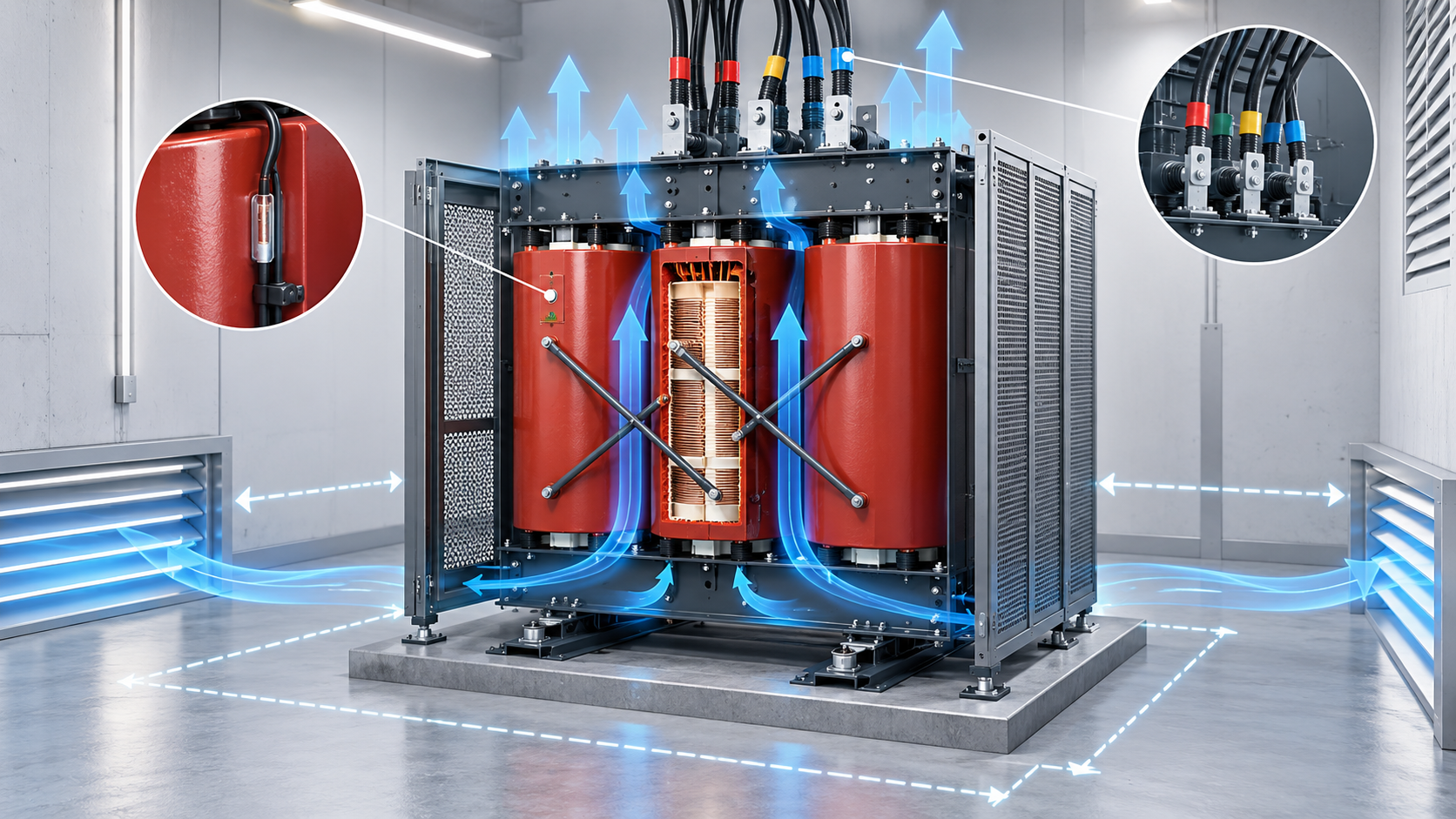
If multiple units share a room, study the airflow arrangement rather than treating each transformer in isolation. Temperature sensors, fan controls and remote alarms are worthwhile where the transformer serves critical loads or operates unattended.
7. Finish with a complete specification and verification plan
A useful request for quotation includes rated power; HV/LV voltages; frequency; vector group; tap range; impedance; insulation and temperature-rise requirements; cooling method; enclosure/IP rating; installation altitude and ambient temperature; standards; losses; accessories; harmonic conditions and required tests.
Typical standards include IEC 60076-11 for dry-type transformers, alongside project-specific IEC, IEEE, ANSI or utility requirements. Ask for routine test records and, when appropriate, type-test evidence, partial-discharge data, temperature-rise results and factory acceptance testing.
The best dry-type transformer is not simply the largest or highest-specification option. It is the one that matches the real electrical duty, environment, protection strategy and life-cycle expectations of the site. With a disciplined load study and complete specification, you can obtain a transformer that operates safely, efficiently and reliably for many years.