Selecting medium-voltage switchgear for a distribution substation usually comes down to a choice between a ring main unit (RMU) and metal-clad switchgear such as the KYN28 type, and the two are not interchangeable despite both switching and protecting MV circuits in the 10-35 kV range. They are built for different points in a distribution network, with different fault-handling capability, different maintenance philosophies and different costs. Understanding the IEC 62271-200 framework that governs both product families makes the choice a matter of matching the equipment to the network role rather than a general preference for one over the other.
What IEC 62271-200 actually classifies
IEC 62271-200 is the standard for AC metal-enclosed switchgear and controlgear above 1 kV and up to 52 kV, and it defines several classification systems that apply equally to RMUs and metal-clad panels, even though the two product types typically land at different points on each scale.
Loss of Service Continuity (LSC) describes how much of the switchgear must be shut down to access one compartment for maintenance. LSC1 (or no classification) means accessing one part of the panel may require de-energising other parts too; LSC2 designs partition the panel so that neighbouring feeders or busbar sections can remain live while one compartment is opened. Partition class (PM or PI) then describes what kind of barrier separates compartments — PM uses metallic partitions, PI allows insulating partitions — which affects how confidently an operator can treat an adjacent compartment as safe to touch while another is open.
Internal arc classification (IAC) addresses a different question: if an internal fault does occur, does the enclosure contain the arc energy so that personnel standing in defined accessibility zones (front, side, rear) are protected? IAC-rated equipment is tested with a defined fault current and duration, and the classification specifies which sides of the panel are protected. This matters most where operators routinely stand in front of live switchgear to operate switches or read instruments.
Ring main units: compact protection for ring networks
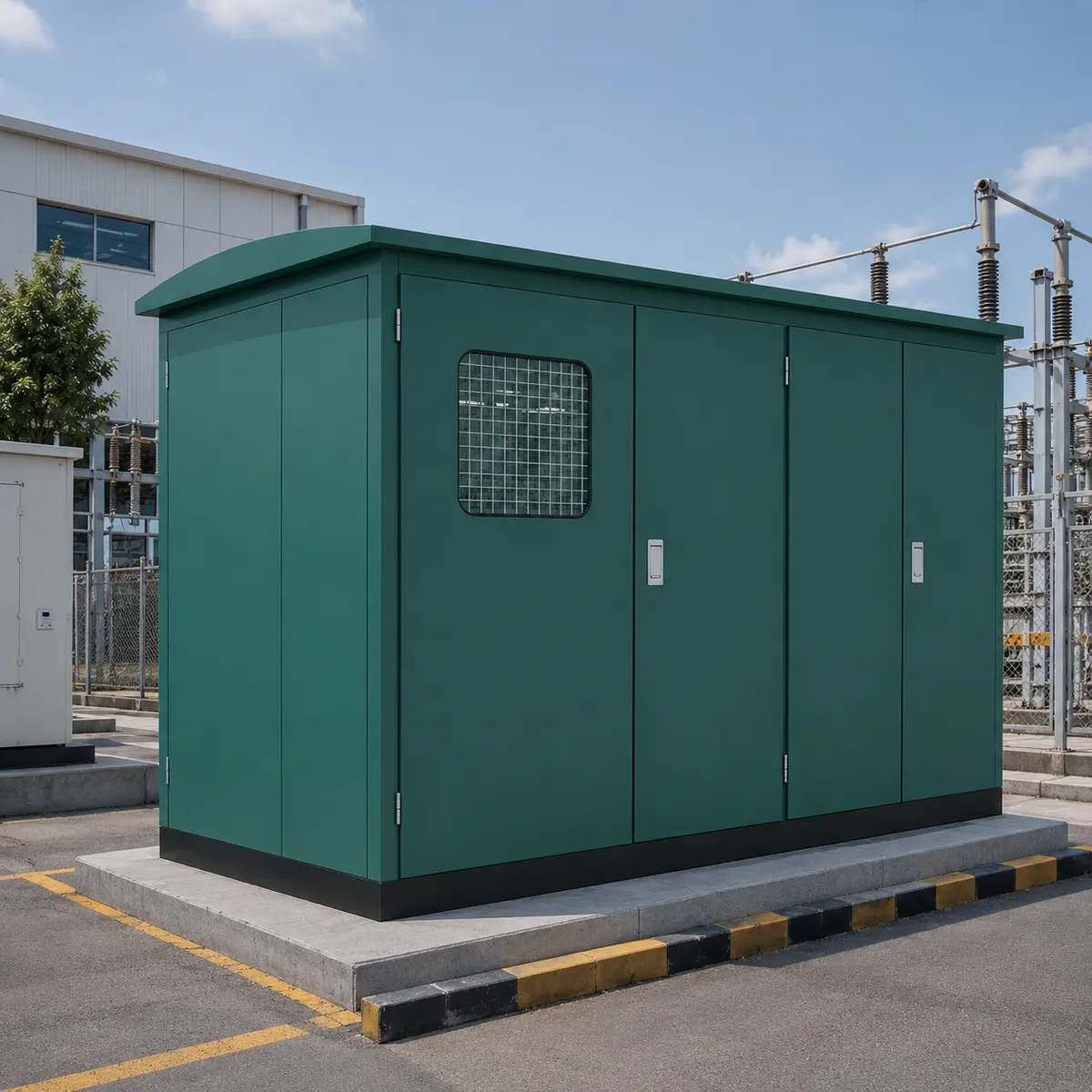
An RMU is a factory-assembled, typically sealed switchgear unit combining two or more ring (incoming/outgoing) feeder positions with one or more transformer feeder positions, all within a single compact enclosure. RMUs are the standard building block of ring or loop distribution networks, where MV supply is looped from one distribution point to the next so that a fault or planned outage at one point can be isolated while supply continues to reach downstream points via the other direction of the ring. Insulation medium varies — SF6 gas has long been the default because of its excellent dielectric and arc-quenching properties in a compact footprint, but solid-insulated designs (using cast epoxy around the conducting parts) and air-insulated designs have both gained ground as SF6-free alternatives, driven by SF6's very high global warming potential and tightening environmental regulation in a growing number of jurisdictions.
RMUs are compact, largely sealed against the environment, and designed for relatively simple protection schemes — often fuse-protected transformer feeders rather than full relay-based protection on every position, though relay-protected variants exist. Their strength is footprint and simplicity: a ring main position at a compact substation or kiosk does not need the same protection sophistication as a primary intake bay, and an RMU's sealed, low-maintenance construction suits installation in kiosks, basements or outdoor cabinets with minimal ongoing intervention.
Metal-clad switchgear: KYN28 and primary distribution
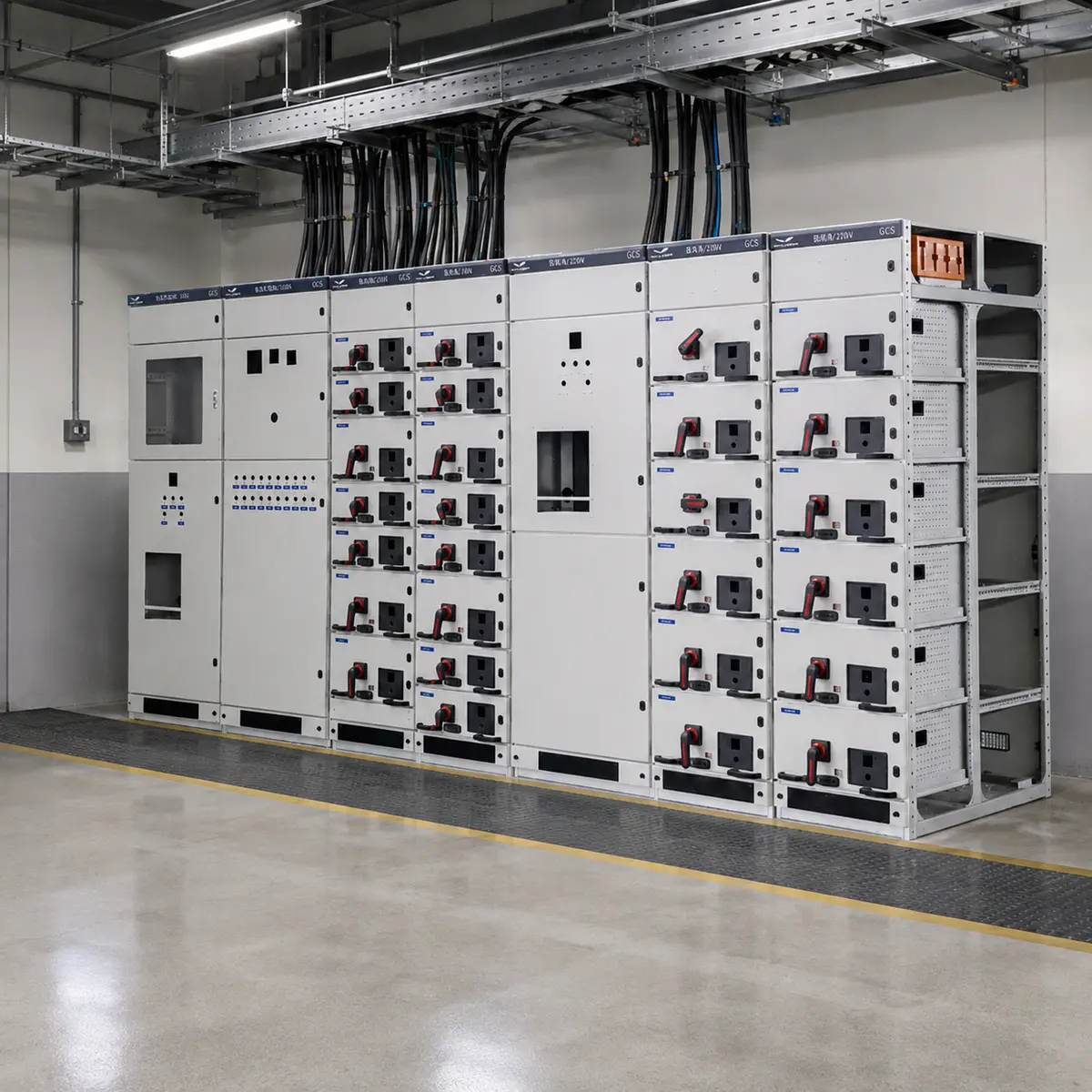
Metal-clad switchgear such as the KYN28 type takes a fundamentally different construction approach. Each functional unit — circuit breaker, busbar, cable, and low-voltage compartments — is separated by earthed metal partitions, and the circuit breaker itself, almost always a vacuum circuit breaker (VCB) in modern designs, is mounted on a withdrawable truck that can be racked out to a test or disconnected position without disturbing the busbar or cable connections. This withdrawable arrangement is the defining feature: it allows a breaker to be removed for maintenance or replacement while the rest of the panel, including the busbar feeding other bays, remains isolated behind fixed shutters rather than exposed.
KYN28-type panels are the standard choice for primary distribution substations, industrial intake points, and any site with heavier fault duty, more frequent switching operations, or a requirement for full multi-function protection relays (overcurrent, earth fault, and often differential or directional protection depending on the feeder's role) on every circuit. Their modular, extensible construction — panels are typically arranged side by side and can be added to a switchboard lineup — also suits sites where the number of feeders is expected to grow over the substation's life, which is harder to achieve with a fixed-position RMU.
Fault levels, extensibility and footprint
Fault level capability is one of the more consistent differentiators: metal-clad KYN28 panels are typically specified with higher rated short-circuit breaking and making currents than compact RMUs, reflecting their role at points in the network where fault contribution from multiple sources is higher. RMUs are rated adequately for their ring-network role but are not generally the equipment of choice where fault levels are high or where future load growth is expected to push fault contribution upward.
Extensibility follows a similar pattern. An RMU is usually purchased and installed as a fixed configuration of positions; adding a feeder later typically means installing an additional RMU or replacing the unit, since the sealed enclosure is not designed for field extension. A KYN28 switchboard lineup, by contrast, is inherently modular — additional panels can be bayed onto an existing busbar run, subject to busbar rating and available switchroom space, making it the more future-proof choice where load growth is anticipated.
Footprint runs in the opposite direction: an RMU with several ring and transformer positions occupies markedly less floor area than the equivalent number of positions in a metal-clad lineup, because the metal-clad design's compartmentalisation, withdrawable trucks and clearances all require more space per feeder. Where a substation site is genuinely constrained — a kiosk, a basement plant room, or a compact substation package — this footprint advantage is often decisive in the RMU's favour even when fault level and extensibility considerations might otherwise favour metal-clad equipment.
Protection, relays and maintenance philosophy
Protection sophistication tends to track the application rather than the switchgear type itself, but in practice metal-clad panels are far more commonly fitted with full numerical multi-function protection relays on every feeder, supporting overcurrent, earth fault, and communications-based protection schemes (IEC 61850 or similar) that integrate with a substation automation system. RMUs more often rely on simpler protection — fused transformer feeders being the classic example — reflecting their role protecting a single transformer or short spur rather than coordinating protection across a busy substation.
Maintenance philosophy differs accordingly. RMUs, particularly SF6 or solid-insulated sealed types, are designed for long intervals between intervention, with the sealed pressure system or solid insulation removing much of the need for internal inspection. Metal-clad switchgear with withdrawable VCBs is designed around the opposite assumption: that breakers will periodically be withdrawn, inspected, tested and eventually replaced without disturbing the rest of the switchboard, which is precisely what the withdrawable truck arrangement is built to support.
Cost and decision summary
RMUs cost less per feeder position than metal-clad equivalents, reflecting their simpler construction, lower fault ratings and reduced protection scope. Metal-clad KYN28 panels carry a higher cost per bay but deliver higher fault ratings, full protection flexibility, withdrawable maintainability and extensibility that an RMU cannot match.
| Consideration | Ring Main Unit | Metal-Clad (KYN28) |
|---|---|---|
| Typical network role | Ring/loop distribution point | Primary distribution / substation intake |
| Fault level | Adequate for distribution ring duty | Higher rated short-circuit capability |
| Extensibility | Fixed configuration, limited field extension | Modular bay-by-bay extension |
| Footprint | Compact | Larger per feeder |
| Protection | Often fuse-protected or simple relay | Full numerical multi-function relays standard |
| Breaker maintenance | Sealed, low intervention | Withdrawable VCB, designed for periodic maintenance |
| Insulation trend | SF6, solid-insulated or air-insulated alternatives | Vacuum breaker with air- or solid-insulated busbar |
| Relative cost | Lower per position | Higher per bay |
Talk to Millenium
Send us your fault level, feeder count and site footprint constraints and we will recommend whether an RMU, KYN28 metal-clad lineup, or a mixed arrangement best fits your distribution substation, along with a specification and quotation. Reach our team at jensen@millenium-electric.com or WhatsApp +86 175 0213 9434.